

Closer to Luther: Brother Ken Taylor’s Trip to Germany and Sabbath Grant
In March of this year, Brother Ken Taylor, Pastor of Saint Nicholas Lutheran Church in Huntingtown, MD, had the opportunity to participate in the 28th International Theological Seminar for pastors hosted by the Lutheran World Federation (LWF) Center Wittenberg in Germany. With the aid of a sabbath grant through the synod’s New and Renewing Missions Table, he represented our Metro D.C. Synod, the ELCA, and the Order of Lutheran Franciscans. The seminar convenes pastors from LWF member churches across the world to explore the theological, dogmatic and historical background of the Nicene Creed as well as its Lutheran interpretation. This year’s was attended by 16 theologians and active pastors from 13 countries: Brazil, Denmark, Finland, South Africa, Canada, Latvia, Hungary, Germany, Nigeria, Slovakia, the United Kingdom, the United States of America, and Tanzania. Read more about his experience in his own words:

The two-week seminar was divided into a week of teaching from retired Canadian Professor Gordon Jensen, which was a series of “back to basics” discussions covering the Augsburg Confession, Luther’s writings on the Lord’s Prayer, the German Mass, and other works. Dr Jensen stressed that in worship, the presence of Christ in the Eucharist, in the Bread and Wine, actually creates change in people’s lives, and thus, whole communities can be changed by the power of Christ’s presence. We also discussed the idea that Luther was not interested in changing very much about the Order of Worship initially, and yet, the orders of worship that were introduced were not intended primarily for those who already are Christians, but for those who are becoming Christians. In this context, Luther explicitly and intentionally focuses on young people. He argues, among other things, in favor of a diversity of liturgical forms and for a language through which the gospel can be proclaimed and understood in common language and culture. This is obvious as it echoes Luther’s commitment to translate the Scriptures in the common language, and to prepare Catechisms for the purpose of teaching the rudiments of the Gospel.
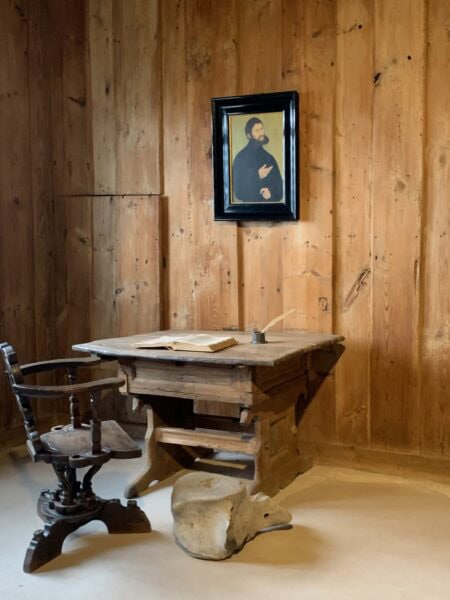
The weekend included a trip to Eisenach to visit Luther’s childhood home, which was interesting for me to discover that the family that hosted Luther were Third Order Franciscans! We also had a nice tour of Wartburg Castle to see the room where Luther, disguised as Junker Georg, began the process of translating the New Testament. The next morning was a huge highlight for me: I was able to sing and play on guitar the communion hymn, “One Bread, One Body,” in the same church were Luther often preached and where the famous triptych of Lucas Cranach hangs behind the Altar.

The second week’s studies focused mainly on Liturgy and was taught by German theologian Dr. Dorothea Haspelmath-Finatti, who is currently teaching at the University of Vienna, Austria. One of the main topics for the week was how the liturgy itself not only transforms those who celebrate it, but, in and through them, the entire world in eschatological and cosmological perspectives. She also stressed the concept of concentrating on what we “receive,” both in our cultural heritage and in historic liturgies, but also in the time of worship itself.
During this second week, I also had the privilege of visiting the home of a retired music teacher whom I had met the previous week at a congregational gathering. It was fascinating to hear what it was like to grow up during the years under the East German authoritarian government. Later in the week, I also visited a local musician and was delighted to hear her play her Viola de Gamba and some other instruments.

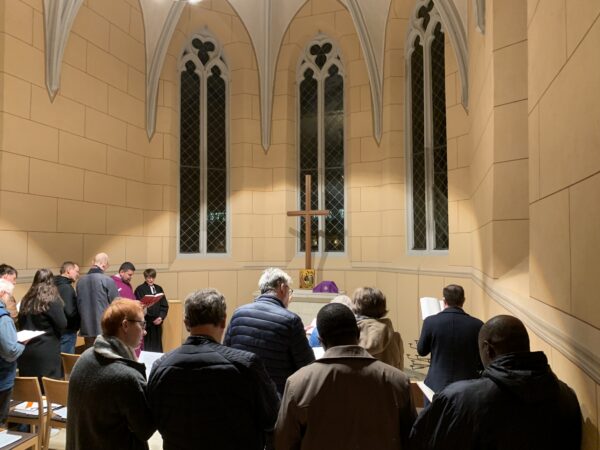
A major highlight for me was making numerous friends from around the globe who are pastors and to learn from their contexts and to hear their ideas, and their struggles. Each night we had presentations of each representative about their local contexts. We also held worship every morning and every evening, offered by a different pastor, and their own contexts. One delightful midday prayer moment happened every day at noon. When the bells rang for midday, we interrupted our work and celebrated a short liturgy together—psalm prayer, a biblical reading, and a prayer for peace—simultaneously with the congregation of St. Mary’s Church in Wittenberg, and we prayed the Lord’s Prayer in our native languages. We were together as participants from 7:30 in the morning until 8:30 or 9 at night on most days, which was followed by fellowship time in the common room.
Thank you to the New and Renewing Missions Table of the Metro D.C. Synod for helping with this amazing opportunity. I also feel very fortunate to have had this experience as the only ELCA participant. I am deeply thankful.
+brother ken